Showing posts with label Verizon VOD. Show all posts

Friday, April 04, 2014

Mulling a TiVo Roamio (Part 7)

In earlier posts in this Mulling a TiVo Roamio series I compared the costs of buying TiVo boxes with using the combination of Verizon FiOS DVR and two non-DVR settop boxes I now have. The TiVo units I opted for are one Roamio Plus DVR and two Mini extender boxes, along with a TiVo MoCA adapter that will let me network my current TiVo Premiere with the new TiVos.

(I ordered my new TiVo gear online at TiVo.com last Saturday, by the way, and it arrived five days later, on Thursday. I will hook up the Roamio Plus soon, this coming Saturday. The other boxes will be hooked up later.)

My cost comparison involved buying lifetime service on the new TiVo boxes, to go with the lifetime plan I already have on my Premiere. I would thus receive a multi-system discount (MSD) on Roamio Plus lifetime service, I said, such that I would save enough in monthly outlays to cover my initial TiVo expenditures after just 32 months (26 months if I also give up Aereo).

Buying the TiVo combination seemed a really smart move, partly because it has better capabilities than my current Verizon whole-house gear: more tuners for recording more shows at one time; more storage for holding more recorded material; the ability to stream live or recorded shows to my iPad or iPhone.
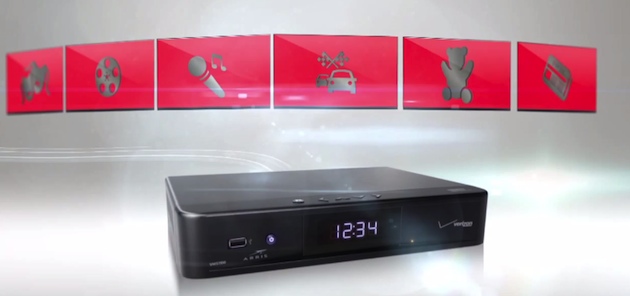
Verizon FiOS's VMS1100
Quantum TV Media Server


Then yesterday a friend e-mailed me a link to a Gizmodo story about Verizon FiOS's latest settop box, the VMS1100 Quantum TV Media Server. I then went and found this story about the VMS1100 at Endgadget. The VMS1100 is shown on the Verizon website here. An Installation & Operation Manual for the VMS1100 is here.

The VMS1100 Media Server has six tuners and 1 terabyte of storage, as does the Roamio Plus. Impressive.

The Gizmodo story says of the VMS1100 that "you can add a second DVR unit to record up to 12 channels at once and feed 10 TVs at any given time," according to Verizon. So you can have two (or possibly more?) VMS1100s in your FiOS home hookup; the Installation & Operation Manual in fact states that you need a pair of VMS1100s if you want to feed more than five TVs at a time.

I suspect that you can do exactly the same thing with a pair of TiVo Roamio Pluses and the requisite number of Minis, but I do not know that for sure.

Gizmodo says that "it'll cost you $22 a month for the [first VMS1100] box, an extra $32 for the two-DVR, 12-tuner setup, plus $10 to connect additional TVs." Ignoring the double-DVR possibility, the monthly cost for one VMS1100 with two extender boxes seems to be $32 + $10 = $42. Or is that $10 for each additional TV, thus $52 for the three-TV setup?

Gizmodo continues, "Perhaps more excitingly, a second phase of development will see Verizon transcoding its video so that the service also works with other hardware, like Xbox, Roku or iPad." That sounds intriguing ... but as far as use with an iPad is concerned, the Roamio Plus already streams live and recorded TV to TiVo's iPad app.

Hookup diagram from the
VMS1100 Installation & Operation Manual
("Embedded MoCA" refers to support
for MoCA, which I talk about here.)


If a next-generation Verizon Media Server one day comes to use Xbox, Roku, etc. as whole-home extenders, it might be the case that apps situated on those devices would obviate Verizon's own extender set-top boxes (which I believe are called the IPC1100). That would pleasantly lower the consumer's monthly bill for equipment rental.

I note that TiVo does not currently support client apps running on Xbox, Roku, PlayStation, Wii, Apple TV, etc. The clients it now supports reside on handhelds such as the iPad and iPhone. So what Verizon seems to be planning would exceed what is now possible with the TiVo gear I am currently installing.

My earlier posts made the point that buying TiVos along with lifetime service plans saves money in the long run, compared to renting a Verizon multi-room hookup on a month-by-month basis. The big question is how many months the payback period is. I calculated the payback period to be 40 months for one new Roamio Plus and two new Mini boxes, based on Verizon's $40 charge for a three-TV DVR hookup and the $5/month cost of the CableCARD required for the Roamio Plus.

If the cost for a Verizon three-room hookup based on a VMS1100 Media Server exceeds $40, the payback period is concomitantly shorter.

I said in an earlier post that multi-room DVR service from a cable company might be costing you too much money. If you were to invest in TiVo gear, you might save on your overall monthly outlays. You might find that the cost of the TiVo option would be, over time, fully offset by those savings.

Yet there are two big risks. First, the TiVo gear one buys — I'd say the Roamio Plus DVR is more apt to fail than the Mini — may stop working after the limited warranty period of one year is up but before the anticipated payback period is complete.

Second, one's TiVo boxes may become outdated before payback is fully accomplished. One may find that some cable company brings out gear, such as Verizon's next-generation Media Server, that is even better than what's arriving even today, and one is meanwhile stuck with TiVo boxes one hasn't yet "paid for" with month-by-month savings.



Wednesday, April 02, 2014

Mulling a TiVo Roamio (Part 6)

In the earlier posts of my Mulling a TiVo Roamio series, I've been describing how I intend to replace my current Verizon FiOS DVR box and two non-DVR cable boxes with gear I purchase from TiVo. The gear includes a TiVo Roamio Plus DVR ($400), a TiVo Mini ($100), and a TiVo MoCA Network Adapter ($50) for the TiVo Premiere I already own.

TiVo Roamio Plus

As a result of my last post, I've come to think it would be best for me to buy lifetime service for the Roamio Plus and the Mini, instead of paying for TiVo service month by month. I can get lifetime service on my new gear at the following itemized costs:

TiVo Roamio Plus lifetime service, $500
TiVo Mini lifetime service, $150

Total for lifetime service: $650

Total for lifetime service including initial hardware cost: $550 (hardware) + $650 (lifetime service) = $1200

Now comes the crucial cost comparison.

With lifetime service on all my TiVo boxes, my current monthly outlay would be reduced by $40 (present cost of my Verizon boxes) - $5 (Verizon's charge for one extra CableCARD for the Roamio Plus) = $35 per month.

The payoff period for recouping my initial outlay, with lifetime service included, would be $1100 ÷ $35/month = approx. 35 months, or 2 yrs. and 11 mos. That compares with 40 months if I pay for TiVo service month by month.

* * * * *

It gets even better. It looks like I would be eligible for a multi-system discount (MSD) on the Roamio Plus, based on my already having purchased lifetime service on the TiVo Premiere.

The amounts charged for TiVo's lifetime service plans, with and without multi-system discounts, are detailed here, and TiVo's terms of MSD eligibility are here.

TiVo Mini

Note that the TiVo Mini I intend to buy is not eligible for the MSD. But I might reduce my payoff period even further by taking advantage of TiVo's offer of the MSD on the Roamio Plus:

TiVo Roamio Plus lifetime service with MSD, $400
TiVo Mini lifetime service without MSD, $150

Total for lifetime service: $550

Total for lifetime service including initial hardware cost: $550 (hardware) + $550 (lifetime service) = $1100

Time to payoff: $1100 ÷ $35/month = approx. 32 months, or 2 yrs. and 8 mos.

So, taking all the above into consideration, I might reduce my payoff period by 20%, from 40 months to 32 months, if I get lifetime service on the Roamio Plus and on the Mini, and I get the multi-system discount on the Roamio Plus.

* * * * *

Aereo logo
Further note: If I drop Aereo, the service I have which streams/records my local channels, and which I now get for $8 a month, my monthly savings would rise from $35/month to $43/month, and my time to payoff becomes $1100 ÷ $43/month = approx. 26 months, or 2 yrs and 2 mos.

In that scenario, the difference between 40 months and 26 months represents a 35% reduction in the length of my payoff period.

Dropping Aereo makes sense because I expect to be able to use the streaming ability of the Roamio Plus to view local channels on my iPad and my iPhone, just as I do now in Aereo.


Tuesday, April 01, 2014

Mulling a TiVo Roamio (Part 5)

In the first four posts of my Mulling a TiVo Roamio series, I described how I intend to replace my current Verizon FiOS DVR box and two non-DVR boxes with gear I purchase from TiVo.

Verizon FiOS DVR
(Cisco CHS-435)

Specifically, I want to replace the Verizon DVR with a TiVo Roamio Plus, and the two other cable boxes with:


  • A new TiVo Mini, and
  • A 2010-model TiVo Premiere that I already have but use very little


I did a cost analysis in Mulling a TiVo Roamio (Part 4) in which I determined I'd be paying off the $550 cost of the new TiVo hardware in 3 yrs. and 4 mos., given that I'd be spending, on net, $14 a month less than my current $40/month outlay for a three-way multi-room DVR hookup from Verizon.

It worked out that way in large part because I long ago purchased the Premiere along with "lifetime" TiVo service for that unit. What would my scenario look like if I were instead starting from scratch?

Instead of relying on the Premiere (along with the TiVo MoCA network adapter it needs to be able to stream TV content from the Roamio) I would buy a second TiVo Mini (which, like the first, needs no adapter because it has MoCA support built in).

See Mulling a TiVo Roamio (Part 2) for an explanation of what MoCA is and why it is needed.

The hardware costs for this scenario would be:

TiVo Roamio Plus, $400
First TiVo Mini, $100
Second TiVo Mini, $100

Total: $600

The theoretical costs of TiVo service:

For the Roamio Plus, $15 a month
For the first Mini, $6 a month
For the second Mini, $6 a month

Total: $27 a month


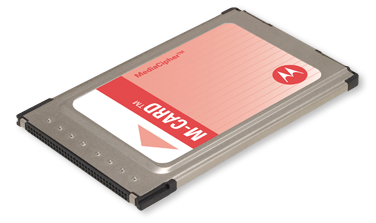
Motorola "M-Card"
CableCARD is
the size of a calling card
Under these assumptions, you'd be paying Verizon $5 a month for the Roamio Plus's required CableCARD. Note that the two Mini units require no CableCARDs.

You'd be dropping the $40/month charge now paid for Verizon's boxes. So the saving in monthly outlays would come to $40 (present cost of Verizon boxes) - $27 (anticipated cost of TiVo service) - $5 (Verizon's charge for one CableCARD) = $8 per month.

At that rate, the $600 up-front cost of TiVo hardware would be offset over the course of ($600 ÷ $8/month in net savings) = 75 months, or six years and three months.

* * * * *

Assume, now, that you'd opt for TiVo "lifetime" service, not monthly service (see this page detailing TiVo's service plans):

For the Roamio Plus, $500
For the first Mini, $150
For the second Mini, $150

Total: $800
Total including cost of hardware: $800 + $600 = $1400

Now your current monthly outlay would be reduced by $40 (present cost of Verizon boxes) - $5 (Verizon's charge for one CableCARD) = $35 per month.

At that rate, the $1400 up-front costs of TiVo hardware and service would be offset over the course of ($600 ÷ $35/month in net savings) = 40 months, or three years and four months. Springing for TiVo lifetime service cuts your payback period nearly in half, from 75 months to 40. After 40 months, you could toss the TiVo boxes in the landfill and still have spent no more money than if you'd stayed with Verizon's gear!

* * * * *

And that's the lesson. Each potential consumer's details will differ, but the general principle here is that multi-room DVR service from a cable company might be costing you too much money. If you were to invest in TiVo gear, you might save on your overall monthly outlays. You might find that the cost of the TiVo option would be, over time, fully offset by those savings.


Monday, March 31, 2014

Mulling a TiVo Roamio (Part 4)

Last time, I discussed a scenario in which I'd hypothetically buy a TiVo Roamio to replace my current Verizon FiOS DVR. In that scheme, I'd also buy a TiVo Mini to replace one of my two non-DVR Verizon boxes, with the Roamio able to send live or recorded TV programs to the Mini for viewing on the associated TV. My third TV would be served by the TiVo Premiere DVR I already have, and I'd relinquish the Verizon box now associated with that TV.

Coaxial TV cable
To get the Roamio to stream live and recorded fare to the TiVo app on my iPad, I'd buy a TiVo Stream external adapter for the Roamio. To each of the TiVos other than the Mini, I'd add TiVo's external MoCa network adapter, since MoCa is what allows these boxes to stream video fare over the coaxial cabling in my home. This cabling is what transmits the Verizon channels I subscribe to to my Verizon boxes, and it would remain in place even if I give up the Verizon boxes.

That scenario would involve $530 in up-front hardware costs. It would save me the $40 I now pay every month to Verizon for my three boxes. I'd instead pay $5 for a new CableCARD for the Roamio (the Premiere already has a $5 CableCARD). The CableCARD would let the Roamio access all my current Verizon channels (though not the Verizon video-on-demand programs I now have access to). I'd also pay $21 a month to TiVo for service to my Roamio and Mini (the Premiere has lifetime service already paid for).

On net, I'd be saving $14 a month ... which over a little more than 37 months would pay for the new TiVo hardware.

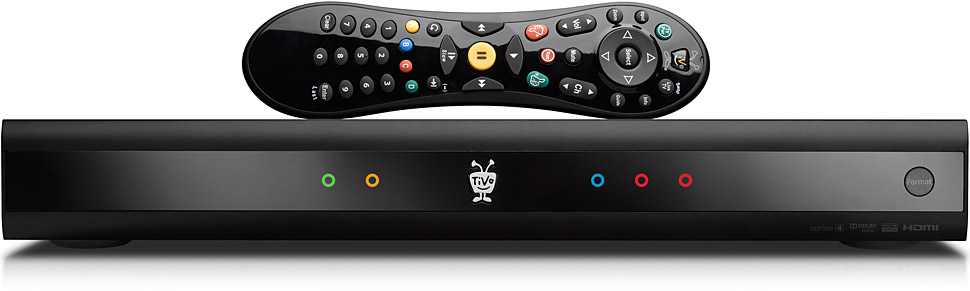
TiVo Roamio Plus DVR ($400)

But now I have an even better scenario in mind. I'd change the Roamio, which costs $200, to a Roamio Plus, at $400. That would let me drop the $130 TiVo Stream unit I'd originally contemplated, as the Roamio Plus has the equivalent streaming functionality built in. It also has built-in MoCA compatibility, so I wouldn't need a $50 MoCA adapter for it. Accordingly, switching to a Roamio Plus would add just $20 to my total hardware cost.

The revised hardware list would be:

TiVo Roamio Plus, $400
TiVo MoCA network adapter for TiVo Premiere, $50
TiVo Mini, $100

Total: $550

The Roamio Plus records up to 150 HD hours using six tuners (for up to six simultaneous recordings) and fully 1 terabyte of storage, compared with 4 tuners/75 HD hours/500 GB. It has, as I say, TiVo Stream functionality and MoCA support built in. It can even stream live and recorded TV to the iPad (or iPhone) TiVo app outside my home, wherever I have a WiFi connection; using the base Roamio and the TiVo Stream dongle, I would first have to download each recording to the iPad before leaving home, if I wanted to view it on the road. Those combined advantages seem to me to justify the extra $20 in up-front costs.


The costs for TiVo monthly service in the Roamio Plus scenario would remain $21 a month. Dividing $550 by my overall monthly savings of $14 a month yields a time-to-hardware-payoff of just under 40 months, or 3 yrs. and 4 mos. It's only three months more than the payoff period in my original scenario.

Next time, I mention some additional factors that bear upon my time-to-hardware-payoff calculations ...


Mulling a TiVo Roamio (Part 3)

In my first post in this series, I stated my desire to have all my TV and video streaming channels, all the time, on all my devices, wherever I go. After a nod toward "cord cutting" — getting rid of my Verizon FiOS TV service entirely, along with the three cable boxes in my home — I said the idea currently presents several hurdles. Then in the second post I took a detour to talk about MoCA, a technology that allows cable-TV companies such as Verizon to stream television programs from one DVR box to another box within a home, using the same coaxial cables that lead from the world outside the home to each box in the home.

TiVo boxes now likewise use MoCA to provide the user with the same multi-room DVR experience. So now I'll go into more detail about my intention to replace my Verizon FiOS DVR and my two associated non-DVR cable boxes — I now have a three-way multi-room setup with Verizon — with TiVo gear.

My first contemplated scenario would center on a $200 TiVo Roamio DVR. The Roamio is the entry-level DVR in the present TiVo lineup.

TiVo Roamio DVR

More pricey options include the Roamio Plus ($400) and the top-of-the-line Roamio Pro ($600).

Opting for a base Roamio, I'd have to augment it with a TiVo Stream unit ($130) if I want to be able to stream Roamio-recorded TV programs to the TiVo app on my iPad.

TiVo MoCA
Network Adapter ($50)
Given that I already have a 2010-model TiVo Premiere in my home, if I want it to be able to play the recordings made on the Roamio into its connected TV, I'd need to make the TiVo Premiere MoCA-capable by connecting it to a TiVo MoCA network adapter ($50).

The MoCA adapter can be looked at on this page at the TiVo.com website. The page "How to connect your TiVo box to your home network, incl. using MoCA" is here. A page illustrating using a MoCA adapter with a TiVo Premiere is here. Using a MoCA adapter with a base Roamio is depicted here.


My third TV also now has a Verizon cable box on it, and currently, that box can play recordings streamed to it from my Verizon DVR. Relinquishing my Verizon DVR would eliminate that convenience, as that third Verizon cable box would be unable to stream recordings from either the Roamio or the Premiere. So, if I want to watch TiVo Roamio or Premiere recordings on my third TV, I would need to replace the third Verizon cable box with a TiVo Mini, for $100.

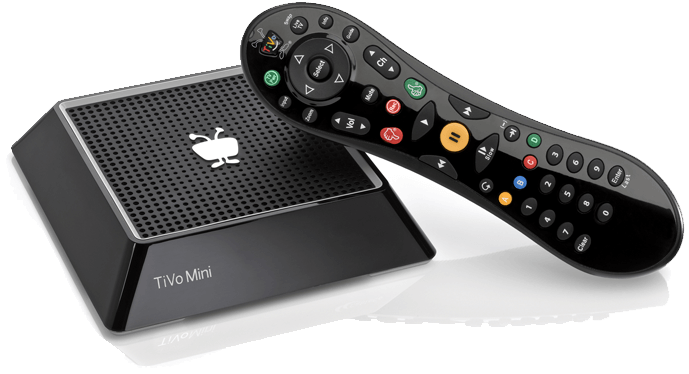
TiVo Mini ($100)

The Mini, lacking a tuner or a hard drive, would not need its own CableCARD. The Mini is intrinsically MoCA-capable, so I would not need a MoCA adapter for it.

So the list of TiVo hardware I'd need would be as follows:

TiVo Roamio, $200
TiVo Stream for the Roamio, $130
TiVo MoCA network adapter for my base TiVo Roamio, $50
TiVo MoCA network adapter for my TiVo Premiere, $50
TiVo Mini, $100

Total: $530


Ongoing TiVo service is also required:

For the Roamio, $15 a month
For the Mini, $6 a month
For the Premiere, $0 a month (I already have purchased lifetime service for the Premiere)

Total: $21 a month


In this scenario, I would give up all three of my Verizon cable boxes, including the DVR box, that now cost me $40 a month to rent, while I would add one additional CableCARD, for the Roamio, for $5 a month. (The Premiere already has its own $5/mo CableCARD.) Net monthly savings on my Verizon bill: $35.

Overall, I would spend $35 - $21 = $14 less than I currently do each month. Dividing the total TiVo hardware cost of $530 by $14 in overall monthly savings, I calculate the TiVo hardware would pay for itself in a little more than 37 months, which is a bit more than three years.

The basic Roamio has a 500GB hard drive that holds up to 75 hours of HD recordings/650 hours of SD recordings, while the Verizon DVR is a Cisco CHS-435 unit with a 160GB drive holding up to 18 hours HD/80 hours SD.

TiVo
iPad app
The Roamio has four tuners and can record up to four shows at a time while playing back a fifth. The Verizon DVR has two tuners and can record two shows while playing back a third. So the TiVo Roamio is by far the more capacious and flexible unit. Plus, adding a TiVo Stream to it would let it stream live or recorded TV to the free TiVo iPad app, a feature the Verizon DVR lacks.

Fair warning: in later posts I'll modify this scenario to show what I consider to be an even better one ...


Mulling a TiVo Roamio (Part 2)

In Mulling a TiVo Roamio (Part 1) I talked about my desire to have all my TV and video streaming channels, all the time, on all my devices, wherever I go. After a nod toward "cord cutting" — getting rid of my Verizon FiOS TV service entirely, along with the three cable boxes in my home — I said the idea currently presents several hurdles.

On the other hand, I could get pretty close to my dream of all my channels, all the time, on all my devices, wherever I go, if I buy some of the latest DVR boxes from TiVo. I said the centerpiece might be a TiVo Roamio DVR. In a later post, I'll talk in detail about that possibility, along with the other gear I'd need. For now, though, I want to mention how I'd tie multiple TiVo units together in a home network, such that recordings made on my Roamio could be viewed on my other TiVo units.

The secret is MoCA.

MoCA hookup in a typical household


Whole-home, box-to-box streaming of TV content depends on MoCA. Formally, MoCA stands for "Multimedia over Coax Alliance." It uses coaxial cables in the home — the same interconnected physical cables that join all of the cable boxes and other devices to the outside cable network — to let a DVR (shown in Bedroom 1) stream recorded TV shows to other boxes and devices in the home.

A Verizon FiOS installation automatically implements MoCA for its users. It may do so in the router that comes with Verizon's Internet service. I am also told it might do so in the Optical Network Terminal module attached to the wall of each customer's home. Truth to tell, I'm not exactly sure where FiOS's MoCA support is actually situated. Wherever it is, it would persist, I believe, if I gave up all of my Verizon cable boxes. (I would just use my existing network of interconnected physical cables to hook up the TiVo boxes I envision buying.)

TiVo Premiere DVR


That's good, because using a TiVo Roamio and my existing TiVo Premiere to shunt TV recordings to/from one another requires the use of MoCA — or else, if not MoCA, interconnected Ethernet cabling, which I do not happen to have installed. In-home video streaming requires more bandwidth than even the fastest WiFi network can provide, which is why either MoCA or Ethernet is needed.

TiVo Mini


If I also purchased a TiVo Mini to act as a conduit to my third TV, it would receive both recorded and live TV fare from the Roamio and from the Premiere via MoCA. If I did not already have a MoCA network in my home, I would have to create one. I would attach a (second) MoCA network adapter to my existing Verizon-provided Actiontec router in order to do so.


But I already have MoCA, courtesy of Verizon, so the second $50 MoCA adapter is unnecessary.

Next, a fleshed-out version of my anticipated hardware purchase ...


Mulling a TiVo Roamio (Part 1)

"TV everywhere" is the buzz-phrase for watching ...

  • all your TV channels
  • all your online streaming video sources, such as Netflix
  • all your video-on-demand content
  • etc.

... on every ...

  • TV
  • desktop computer
  • laptop
  • tablet
  • and smartphone that you own ...

... anywhere in your home, and likewise when you are away from home as well.

I've been thinking I'd like to make all that happen by "cutting the cord": getting rid of my Verizon FiOS cable TV service and the three Verizon cable boxes I now have in my home. (I'd expect to keep my FiOS broadband Internet and landline telephone services, though.)

TV content is increasingly available via online streaming, instead of over traditional copper wire or up-to-date fiber-optic cable physically connected to your house. Online TV streaming à la Netflix does accordingly seem to be the wave of the future. For one thing, it can — in concept at least — feed any video content to any digital device anywhere.

Presently, though, there seem to be several hurdles to my cutting the cord. For instance, there is as yet no way I can stream FOX Sports Channel, part of my current Verizon channel lineup, to my iPad's FOX Sports Go app – as long as I stay with Verizon, that is. The FOX Sports Go app supports other cable TV outfits, but it doesn't support Verizon.

Even so, today's cable TV, whether it arrives at my house over copper wire or fiber-optic wire, seems to get me closer to "TV everywhere" than any other option available right now, including cord cutting.

TiVo Roamio DVR, $200

Which is why I've been looking into the latest DVRs in TiVo's Roamio lineup: the entry-level TiVo Roamio, the TiVo Roamio Plus, and the TiVo Roamio Pro.

TiVo was an early pioneer in digital video recorders. More recently the cable companies have pretty much caught up, DVR-wise. The Verizon DVR I have right now is better than the 2010-model TiVo Premiere I also have in my home, in many of the ways I most care about. For instance, the TiVo Premiere never had the ability to stream video in real time to my three older TiVo units.

(None of those older TiVos still work anyway, by the way, owing to power supply or hard drive issues, and I recently turned them in for recycling at my local Best Buy. And the Premiere itself has had to be replaced once, due to a faulty power supply. I am in fact a bit worried about the poor longevity record of TiVo units.)

But my Verizon DVR can't stream live TV or TV recordings to my iPad, as the Roamios can. (The plain-vanilla $200 Roamio, in contrast with the $400 Plus and $600 Pro, needs to be paired with a $130 TiVo Stream unit to do this.)

True, Verizon's FiOS Mobile iPad app does let me watch certain live cable channels, but only certain ones. Not my local over-the-air channels, not my regional sports networks, and not every national cable channel is included in the list of iPad-available channels. Only a few of the channels that the iPad can stream work outside my home. I want all my channels, all the time, on all my devices, wherever I go.

Going the TiVo route, I could replace my Verizon DVR with a basic Roamio for $200, and add a TiVo Stream to it for $130. The Roamio would use a CableCARD from Verizon to receive the Verizon channels I subscribe to.

(Various posts at the TivoCommunity forum indicate that I can pick up the CableCARD I need at the Verizon Store and install it myself. The correct "M-card" part number is 514517-017-00. I can go to this web page for full instructions on self-installing it. At the very end, the process requires entering an activation code that is specified on a Welcome Letter or Customer Receipt I will have received. If I have already completed the earlier steps given in the full procedure, I can also activate the CableCARD by going to this page.)

I believe that combination of TiVo Roamio and TiVo Stream would be able to stream recordings to my existing TiVo Premiere, which already has a CableCARD, as long as I augment each unit, the Roamio and the Premiere, with a $50 MoCA network adapter from TiVo. If I did all that, I could relinquish the Verizon cable box now serving the TV with the Premiere hooked to it. 

(Optionally, I believe I might also hook a TiVo Stream to the Premiere, if I wanted to record iPad-streamable shows on the Premiere, too. However, that option might be overkill at this point; moreover, I'm not exactly sure whether my gear array would work with two TiVo Streams in it.)

My third TV also now has a Verizon cable box on it, and currently, that box can play recordings streamed from my Verizon DVR. Relinquishing my Verizon DVR would eliminate that convenience, as that third Verizon cable box would be unable to stream recordings from either the Roamio or the Premiere. So, if I want to watch TiVo recordings on my third TV, I would need to replace the third Verizon cable box with a TiVo Mini, for $100. The Mini, lacking a tuner or a hard drive, would not need its own CableCARD.

Note that I would lose access to Verizon's video-on-demand content if I gave up all of my Verizon boxes, as CableCARDs are unable to access Verizon VOD.

Next up, a discussion of MoCA ...